
Imagery
Accepted
Aleris images show real people in real places, in natural light, with the person at the centre, so that a patient recognises Aleris before reading a word.


Why it looks like this
The images carry the Present Expert in an instant: calm, competence and human warmth. They rest on three choices: real environments, natural light and the person at the centre. The clinics, employees and situations are real, and credible enough that a patient who visits recognises them. The light is warm and directed, with a shallow depth of field that draws the eye to the person, and equipment, premises and processes are there in support.
Every image tells one of three stories. Life shows why we do what we do: an active, everyday life, the result of care. Care shows what we do and how: the Present Expert at work, with the environment visible and the person dominating. Portrait shows who we are: the employees a patient or partner will meet, looking as they do in reality.
The reader's state decides which story leads. A patient before an assessment or procedure meets Care images first, with a portrait of the person they will meet. A patient who has chosen a health check-up meets Life images first, with Care images to show the expertise behind the promise.
What never changes
Natural light, soft depth of field and the person at the centre
This is the visual signature, and without it the images no longer look like Aleris.
No stock photos
Arranged situations, white backgrounds and smiles with no cause break the promise that what is shown is real.
Portraits of employees are always photographed
Someone seeking care should be able to trust that the person in the image is the one they meet.
AI-generated images never stand in for real people or environments in patient-facing content
An image that implies reality breaks the trust the page rests on, so AI images used externally are labelled "illustration" or "AI-generated".
Care images follow the National Board of Health and Welfare's basic hygiene routines, even when staged
No watches or jewellery on hands and forearms, short nails with no artificial material, and long hair and beards tied up, because an image that breaks hygiene rules undermines the trust it is meant to build.
The image never holds the hero position on a working surface
The top of the screen belongs to the task the person came to do.
How to apply it
Web pages
A website has room for a hero image and supporting images in the flow. Patient pages lead with reassurance and human contact, and partner pages can show more of the work and the competence behind it.
All images in one view share an aspect ratio, set by the component rather than by the image: 16:9 for heroes and banners, 3:2 for articles and content, 1:1 for profile photos and thumbnails, and 4:3 where the subject needs more height.
Location, camera and time data are stripped from every photo before it is published, because a photo taken at a clinic can carry GPS coordinates.
A patient brochure can mix Care and Life images. A poster has a single image that does the whole job.
Campaigns and social
Life images carry landing pages, campaigns, employer branding and annual reports, where the story is why Aleris exists.
Consent differs between markets: in Denmark, written consent is required for all social media use.
Digital products
On a clinician's dashboard, a scheduling view or an admin tool, function leads, there is often no hero image, and decorative lifestyle images do not belong. Most of a treatment app is a working surface too: it may carry images inside components that need them, while the top of the screen belongs to the task.
Instructional images
Images that show someone how to do something are outside these rules, because an instruction needs even light and the hand and the object both in focus. They are decided case by case together with marketing.
What good looks like
Do
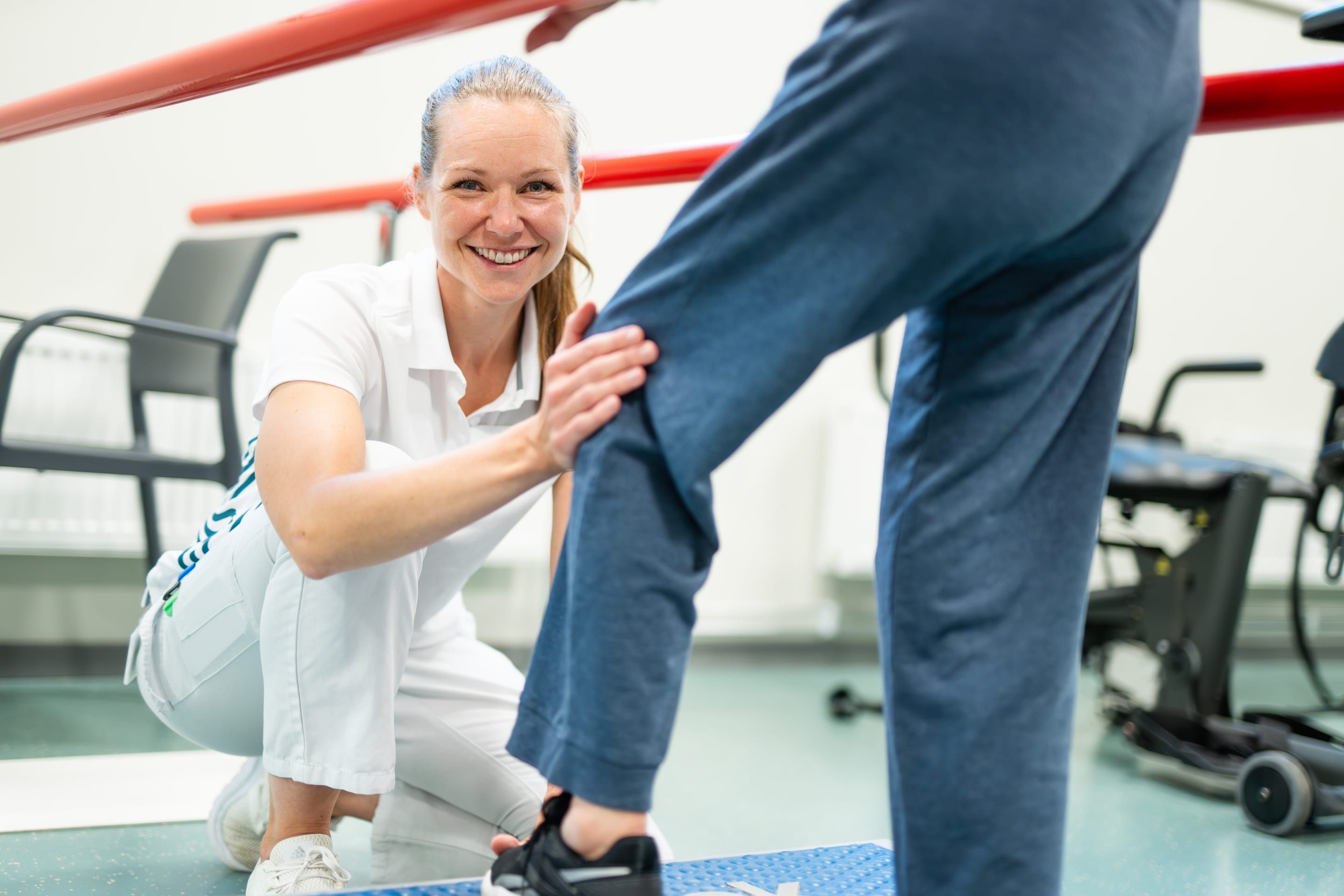
A physiotherapist guiding a patient through an exercise, the room soft behind them
Competence and human contact are in the same image, and the person dominates the environment.
Don't
An empty treatment room with equipment and no person
It communicates an institution, and the Present Expert is missing.
Do
A person walking by the sea on an ordinary day
It shows the result of care, warm and bright without becoming sentimental.
Don't
Two hands holding each other, in close-up
It reaches for emotion, where Aleris shows care through competence and presence.
Do
A Care image as the hero on a page about a cardiac assessment
It answers the patient's uncertainty with competence and a visible process.
Don't
A Life image as the hero on the same page
It risks telling the patient that we do not understand their situation.
Asked about imagery
- Which image rule applies to a screen patients use to get something done, like a weekly check-in?
- What kind of image shows a patient how to do something, like giving an injection?
- What do we need before we publish a photo of a patient or a colleague?
Creating with imagery
Source and status
Accepted
- Last verified
- 2026-08-27
- Owner
- Not recorded
- Depends on
- foundation/colour, foundation/constant-contextual, foundation/emotional-modes
- Read by agents as
- /explore/imagery.md